
You are scrolling through your messages and someone replies with just two letters: IK. No emoji, no explanation, just IK. If you stopped and thought, what does IK mean in text, you are not the only one.This tiny abbreviation shows up everywhere today, from WhatsApp group chats to TikTok comment sections and Instagram DMs.
Understanding IK meaning in chat and across social media helps you read tone correctly, avoid awkward misunderstandings, and text more naturally. Whether it came from a close friend, a crush, or a random person in a group chat, this complete guide breaks down the full IK meaning in text, slang, and every major platform with real conversation examples and everything you need to know.
What Does IK Mean?
Simple Definition
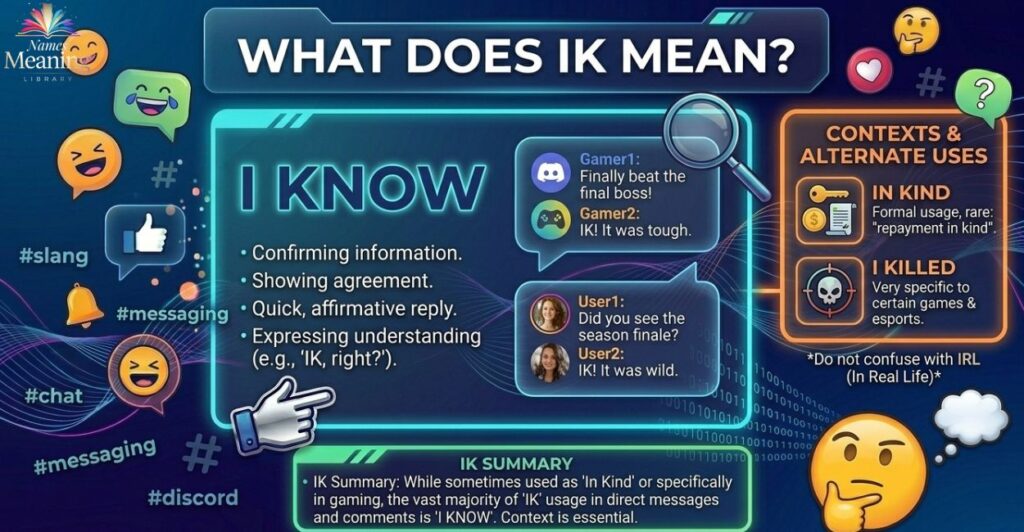
IK stands for “I Know.” It is one of the shortest and most widely recognized abbreviations in digital communication today. When someone sends you IK, they are letting you know they already have the information, they understood what you said, or they agree with your point. No extra explanation is needed, which is exactly why so many people reach for it during fast moving conversations.
IK Full Form
The IK full form is simply “I Know.” There is no alternate expansion in casual texting or online chat. In very rare technical contexts, IK can appear as a field code or identifier in some industries, but in everyday digital messaging, IK always means I Know. Every search for IK full form or IK abbreviation meaning leads to the same clear answer.
Why People Use IK Instead of “I Know”
Speed is everything in modern texting. Nobody wants to type out a full two word phrase when two letters say the same thing just as clearly.
IK grew popular alongside other short forms like IDK, IKR, and FR during the early days of SMS messaging and instant messenger chats. The first recorded definition on Urban Dictionary appeared in October 2004 and described it simply as “Used in IM. Means I Know.”
As smartphones replaced older phones and platforms like Snapchat, TikTok, and Instagram grew into daily habits, IK spread naturally across all of them.
It fits perfectly into comment boxes, DM threads, story replies, and fast group chats. It saves time, keeps conversations flowing, and feels more natural and relaxed than typing the full phrase every single time.
IK Meaning in Text Messages
Everyday Conversations
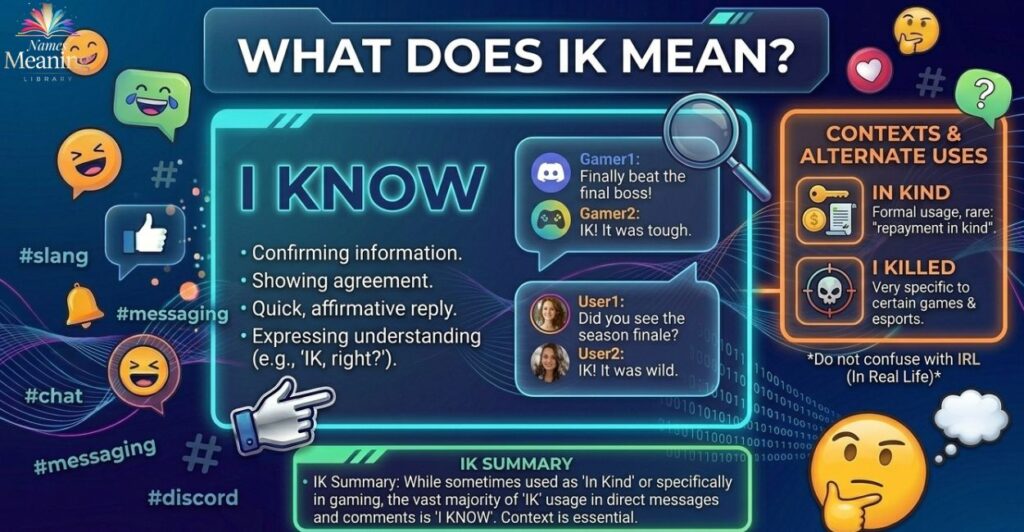
In regular day to day texting, IK is used to quickly acknowledge something the other person just said. It signals that you already know the information and no further explanation is required. Think of it as the digital version of nodding your head without saying a word.
Example: Friend: “The event starts at 7, not 8.” You: “IK, thanks for double checking though!”
Friendly Chats
Between close friends, IK often carries a relaxed and unbothered tone. It can mean “yeah obviously” or “of course I already know that” without coming across as rude. Add a laughing emoji next to it and it immediately feels lighter and warmer.
Example: Friend: “You should probably eat before the gym.” You: “IK lol, I just forgot today 😂”
Group Chats
In group chats, IK is especially popular because it keeps things brief and clean. When someone shares a reminder or a piece of news, a simple IK tells everyone you received the message without starting an avalanche of back and forth replies. It is the perfect no fuss group chat acknowledgment.
IK Meaning on Social Media
Snapchat
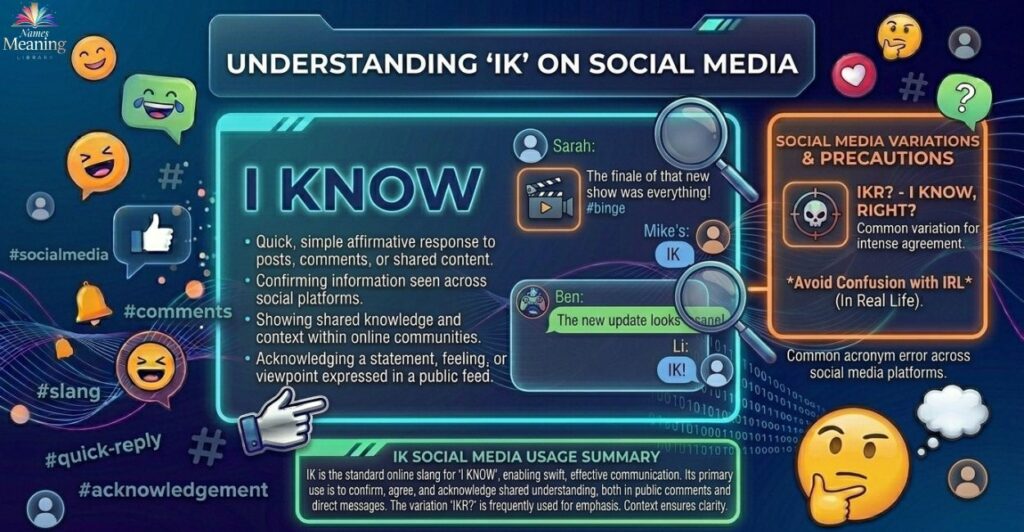
On Snapchat, where conversations move fast and messages often disappear, IK fits the platform perfectly. The IK meaning on Snapchat is exactly the same as everywhere else: I Know. It appears in DMs and group snaps to quickly confirm understanding when someone is sharing gossip, reminding you of plans, or explaining a situation.
TikTok
The IK meaning on TikTok shows up mostly in comment sections under relatable videos. When a creator posts something that feels very real and familiar, viewers drop IK in the comments as a way of saying “same” or “yes, exactly this” without typing out a full response. It keeps the comment section moving at TikTok speed.
On Instagram, IK appears in both DMs and comment replies. The IK meaning on Instagram is used to respond to advice, reminders, or shared opinions in a casual and efficient way. It is especially common in reply threads where quick short responses fit better than long paragraphs.
On Facebook, IK is used mostly by younger users in Messenger chats or post comments. Older users may not always recognize it, which can occasionally cause confusion. In Facebook Messenger specifically, IK works as a clean acknowledgment that you understood the message just shared.
The IK meaning in WhatsApp is identical to its standard definition everywhere else. In both private chats and group conversations, it confirms you received a message or already knew the information being shared. Repeating it, for example “IK IK,” adds emphasis or signals mild impatience when someone keeps reminding you of the same thing.
Discord
On Discord, especially inside gaming servers and close friend groups, IK gets used constantly during casual conversations and live gaming sessions alike. It signals awareness without interrupting the natural flow of whatever conversation or game session is happening at the time.
IK Meaning from a Girl
Positive Meaning
When a girl sends IK in a friendly and warm context, it usually means she agrees with you, relates to what you shared, or feels comfortable enough in the conversation to keep things short. She might pair it with an emoji like 😊 or expand it into “IK right!” to show genuine connection and enthusiasm.
Neutral Meaning
A plain IK without any emoji from a girl typically means she is simply acknowledging what you said. It is not positive or negative. She heard you, understood you, and the conversation continues. There is usually no deeper subtext behind a neutral IK reply.
Annoyed Meaning
If a girl sends IK after you have repeated the same point multiple times or explained something she already told you about, it can carry a slightly frustrated or dismissive tone. In that context, it is the text version of “yes, I already know that.” As always, the surrounding conversation provides the real clue.
IK Meaning from a Guy
Casual Reply
Guys often use IK as their default quick reply when they do not want to type a longer response. It is not personal and rarely means anything beyond a simple acknowledgment. They got the message, they understood it, and they kept the reply efficient.
Agreement
When a guy uses IK to agree with something you said, it usually opens a broader conversation rather than closing it. “IK bro, the same thing happened to me last week.” In this case, IK is the entry point into a shared experience or ongoing discussion.
Ending a Conversation
Sometimes a guy uses IK to signal that a topic is fully settled and there is nothing more to add. A brief IK at the end of an explanation means “got it, we are done here.” It is not dismissive in most cases, just straightforward and to the point.
Different Meanings of IK
I Know
This is the primary and almost universal meaning. In all texting, chat app, and social media contexts, IK defaults to “I Know” unless there is a very specific technical or regional reason for it to mean something else.
Internet Slang
As part of internet slang culture, IK belongs to a family of short acknowledgment terms that includes IKR, IDK, FR, and similar two to three letter abbreviations. These have all become deeply embedded in how people communicate online across every age group.
Business Meaning
IK carries no standard meaning in business communication. Using IK in a professional email or a formal work Slack channel can come across as careless and unprofessional. In any work setting, always write “I understand,” “Noted,” or “Thank you for letting me know” in full.
Gaming Meaning
In gaming environments, IK is used in voice chats, Discord servers, and game lobbies the same way it is used in casual texting. Players drop IK to quickly confirm they received a strategy call or already know the mechanics being explained, without pulling attention away from the game.
Other Abbreviations
In Swedish, IK stands for “idrottsklubb,” meaning sports club or athletic club. In rare technical manuals or field documents, IK may appear as a code or identifier. These uses have nothing to do with everyday texting and should not be confused with the slang meaning.
How to Use IK Correctly
Informal Conversations
Use IK freely with friends, family, and people you are comfortable with when the conversation is casual and relaxed. It works best as a quick single reply that shows understanding or agreement. Pairing it with an emoji or a follow up sentence prevents it from reading as cold or uninterested.
Online Chats
In messaging apps and social media platforms, IK blends in naturally wherever speed and brevity are expected. Use it when you want to keep the chat moving, when someone tells you something you already knew, or when a longer reply would feel out of place in the moment.
Text Messages
In text messages, IK lands best when the tone is already established as casual. If there is any chance your reply might be misread, add a word or emoji alongside it. “IK, already handled it!” reads much warmer and more engaged than a lone “IK” with nothing else attached.
When You Shouldn’t Use IK
Professional Emails
Never use IK in a work email. It looks careless and signals a lack of professionalism regardless of your actual intention. Colleagues and managers expect full, respectful sentences. Replace IK with “I understand,” “Understood,” or “Noted” in every professional email exchange.
Academic Writing
IK has no place in essays, research papers, reports, or any form of academic writing. Academic contexts demand proper grammar, complete sentences, and formal language at all times. Slang and internet abbreviations are never acceptable in this setting.
Business Communication
Whether you are texting a client, emailing a business partner, or messaging someone in a company team chat, always use proper and complete language. Using IK in a business context sends the wrong signal and can make you appear unprepared or unprofessional to the other party.
Also see more 250+ Last Names That Mean Death, Darkness, Shadow & Mystery (2026)
IK Conversation Examples
Relationship Chat
A: “You know I feel ignored when you go quiet like that.” B: “IK, I am genuinely working on it, I promise.”
Family Chat
A: “Do not forget your passport before the trip tomorrow.” B: “IK mom, it is already packed in my bag 😊”
Gaming Chat
A: “The final boss has a weak spot on the left side only.” B: “IK IK, I have been fighting it for the past 30 minutes.”
Social Media Comment
Creator caption: “Why does Sunday evening feel like the saddest time of the week?” Comment: “IK fr, it hits different every single time 😩”
Workplace Chat
A: “The deadline has been pushed to Friday morning.” B: “Got it, I will adjust my schedule accordingly.” (Note: Always use full phrases like this instead of IK in professional spaces.)
IK vs Similar Slang
| Slang | Full Meaning | Tone | Best Used When |
| IK | I Know | Neutral, casual | Quick acknowledgment |
| IKR | I Know, Right? | Enthusiastic agreement | Sharing a strong reaction |
| IMO | In My Opinion | Conversational | Sharing a personal view |
| TBH | To Be Honest | Honest, open | Being candid or vulnerable |
| FR | For Real | Emphasis, agreement | Stressing something is true |
| NGL | Not Gonna Lie | Honest confession | Admitting something real |
| IDC | I Don’t Care | Dismissive, unbothered | Showing indifference |
| IDK | I Don’t Know | Uncertain | When you have no answer |
Common Situations Where IK Is Used
Agreeing
When someone makes a point you fully agree with, IK is the fastest way to confirm it without launching into a longer reply. It keeps the conversation natural and avoids the need to restate what was just said.
Key situations where IK works for agreement:
- Someone states an obvious fact you already accept
- A friend shares an opinion you strongly share
- You want to validate someone’s point quickly and move on
Showing Understanding
IK works perfectly as a clean acknowledgment that you received and understood a piece of information. It replaces “got it” or “okay” in casual contexts and carries the same meaning with even fewer characters.
Expressing Frustration
When someone keeps reminding you of something you already know, sending back IK carries a subtle edge. It signals mild frustration or impatience in a way that feels real without being openly rude. The surrounding tone of the conversation usually makes it clear.
Quick Responses
In fast moving group chats, live comment threads, or rapid back and forth messaging, IK is the go to reply when you want to stay in the conversation without slowing things down. It is participation without friction.
What Does “Ik” Mean in Dutch?
Simple Definition
Ik is the Dutch personal pronoun that means “I” in English. It is the word a Dutch speaker uses to refer to themselves as the subject of a sentence. Unlike many other short Dutch words, ik has one clear and consistent meaning across every region and context, which makes it one of the easiest words to learn correctly from day one.
What Is the Most Common Translation of “Ik” in English?
The most common and only real translation of ik in English is “I.” There is no alternate everyday meaning. Every Dutch sentence that starts with a statement about the speaker, such as what they think, feel, or are doing, will use ik in the exact position where English would use I.
How Is “Ik” Used in Common Dutch Phrases?
Ik shows up constantly in everyday Dutch because people naturally talk about themselves all the time. It appears in greetings, opinions, feelings, and daily routines. Phrases such as ik hou van je (I love you), ik weet het niet (I do not know), and ik ben moe (I am tired) all rely on ik as the anchor of the sentence.
What Are the Grammatical Rules for Using “Ik” in Dutch Sentences?
In a standard Dutch statement, ik comes before the conjugated verb, following the same subject first pattern used in English. In questions, the verb moves in front of ik, a pattern called inversion. Dutch verbs also change their ending slightly when paired with ik, since the ik form of a verb usually drops the final letter of the verb stem.
Can You Provide Examples of Dutch Sentences Where “Ik” Is Used in Different Contexts?
Here are a few everyday examples that show ik in action across different situations.
- Ik werk vandaag. (I am working today.)
- Ga ik mee? (Am I coming along?)
- Ik heb honger. (I am hungry.)
- Waarom ben ik hier? (Why am I here?)
- Ik denk dat het goed gaat. (I think it is going well.)
How Do You Say “I” in Dutch?
What Is the Dutch Word for “I”?
The Dutch word for I is ik. It is a first person singular subject pronoun, meaning it always refers to the person speaking and always functions as the subject of the sentence.
How Is the Dutch Pronoun for “I” Pronounced?
Ik is pronounced like the English word “ick,” with a short vowel sound and a clipped, unaspirated k at the end. In IPA it is written as /ɪk/. The sound is quick and clean, without the softer or drawn out ending that English speakers sometimes add by habit.
Are There Different Ways to Say “I” in Dutch Depending on Formality?
Dutch does not have a separate formal version of ik the way it has a formal version of you (u versus jij). Ik stays the same whether you are speaking to a close friend, a stranger, or a business client. The one informal variation is ikke, a playful or emphatic form often used by children or in casual speech to draw attention to oneself.
How Does the Dutch Pronoun for “I” Change in Different Grammatical Cases?
Ik is the subject form only. When “I” becomes the object of a sentence in English, meaning something is done to or for the speaker, Dutch switches to mij or the shorter me. The possessive form, meaning “my,” is mijn, and the reflexive form, meaning “myself,” is mezelf.
Can You Provide Example Sentences Using the Dutch Word for “I”?
- Ik zie jou. (I see you.)
- Zij helpt mij. (She helps me.)
- Dit is mijn huis. (This is my house.)
- Ik was mezelf. (I wash myself.)
Other Personal Pronouns in Dutch Similar to “Ik”
| Dutch Pronoun | English Meaning | Formality |
| ik | I | Standard |
| jij / je | you (singular) | Informal |
| u | you (singular) | Formal |
| hij | he | Standard |
| zij / ze | she | Standard |
| wij / we | we | Standard |
| jullie | you (plural) | Standard |
| zij / ze | they | Standard |
Common Phrases Using “Ik” in Dutch
- Ik hou van je. (I love you.)
- Ik weet het niet. (I do not know.)
- Ik ben blij. (I am happy.)
- Ik snap het. (I understand / I get it.)
- Ik kom eraan. (I am coming.)
- Ik mis je. (I miss you.)
- Ik heb het druk. (I am busy.)
How to Use “Ik” in Simple Dutch Sentences
Start every basic Dutch sentence about yourself with ik, followed directly by the conjugated verb. Keep the verb in its ik form, which is usually the plain stem of the verb without an extra ending. For questions, flip the order so the verb comes first and ik follows right after. Practicing short, everyday statements such as ik loop (I walk), ik lees (I read), and ik werk (I work) is the fastest way to build comfort with the pattern before moving on to longer sentences.
Why Is “Ik” the Word for “I” in Dutch?
Ik comes from the same Proto Germanic root that gave English its word “I” and German its word “ich.” All three trace back to an ancient Germanic first person pronoun used across early Germanic tribes long before Dutch, English, and German developed into separate languages. As these languages evolved over centuries, the shared root shifted in sound and spelling, leaving Dutch with ik, German with ich, and English with the now fully vowel based I.
Ik in Dutch vs IK in Internet Slang
It is worth noting that the Dutch word ik and the internet abbreviation IK are completely unrelated, despite looking identical. In English texting and social media, IK is short for “I know,” used to acknowledge something casually in a chat. In Dutch, ik is a full grammatical pronoun meaning “I,” used in everyday spoken and written language, not as an abbreviation.
| Term | Language / Context | Meaning |
| ik | Dutch | I (personal pronoun) |
| IK | English internet slang | I know (acknowledgment) |
Is IK Rude?
Depends on Tone
IK is not inherently rude at all. Its tone depends completely on the context, the relationship, and whether it is paired with other words or emojis. A standalone “IK” with no follow up can feel blunt or like the conversation is being shut down. But “IK 😊” or “IK, totally agree!” reads as warm, friendly, and engaged.
Friendly vs Cold Replies
The difference between a friendly IK and a cold one often comes down to just one emoji or one extra word. When tone matters and you are unsure how your reply will land, take two extra seconds to add something alongside IK. It makes a real difference in how the other person receives the message.
Common Mistakes When Using IK
People make a few recurring mistakes with IK that are easy to avoid once you know what they are:
- Using IK in professional emails or work messages where full language is expected
- Sending a bare IK when someone shares something emotional or serious, which can feel dismissive and hurtful
- Confusing IK with IKR, which carries a much stronger enthusiastic agreement compared to the more neutral IK
- Typing IK in a semi formal situation with someone you do not know well, where it can come across as too casual or lazy
- Relying on IK in every reply to the point where it stops feeling like genuine engagement in the conversation
700+ Goofy Ahh Names For Boys, Girls, Kahoot & Roblox (Funny, Weird & Viral Ideas)
Related Internet Slang Terms
IKR
IKR stands for “I Know, Right?” It adds enthusiastic shared agreement or mild surprise on top of simple acknowledgment. “She actually said that? IKR, I could not believe it either.”
IMO
IMO means “In My Opinion.” It signals that what follows is a personal perspective rather than a stated fact. Commonly used when sharing takes, preferences, or opinions online without wanting to sound too definitive.
TBH
TBH stands for “To Be Honest.” It introduces a candid or sometimes vulnerable statement. “TBH I was anxious the entire time but pretended I was fine.”
SMH
SMH means “Shaking My Head.” It expresses disappointment, disbelief, or quiet frustration about something. “He showed up an hour late with no explanation. SMH.”
FR
FR stands for “For Real.” It emphasizes that something is genuinely true or signals strong agreement with what was just said. “FR this is the best thing I have eaten all year.”
BTW
BTW means “By The Way.” It introduces an extra piece of information that was not part of the main point of the message. “BTW, the venue actually changed to downtown.”
IDK
IDK stands for “I Don’t Know.” It is the direct opposite of IK and is used when you are unsure, have no answer, or want to express genuine uncertainty about something. “IDK what I want, everything on the menu looks amazing.”
FWIW
FWIW means “For What It Is Worth.” It introduces an opinion or piece of additional information that may or may not be fully relevant to the situation. “FWIW, I heard the new location is actually better than the old one.”
Why IK Feels Different Depending on Who Sends It
One of the most commonly searched questions around this abbreviation is whether IK changes its meaning based on who sends it. The short answer is: the words stay exactly the same, but the emotional weight behind them shifts depending on the relationship.
When a close friend sends IK, it feels breezy and completely natural. When someone you barely know sends it, it can feel unexpectedly terse. When a romantic interest sends it, people tend to over analyze every possible tone behind those two letters.
This is one of the fundamental quirks of digital communication. Text strips away vocal tone, facial expressions, and body language entirely. A two letter reply removes almost all of that context in one move.
The best approach is always to look at the full conversation, consider the person’s usual texting style, and check whether any emojis or follow up messages were attached.
See our collection TH Meaning: What Does TH Mean in Text, Chat & Social Media?
The History and Evolution of IK as Internet Slang
IK did not appear overnight as part of some new social media trend. It belongs to the very first generation of internet abbreviations that emerged alongside AOL Instant Messenger, early online chat rooms, and the first wave of SMS texting in the late 1990s and early 2000s.
Character limits on text messages were tight, typing on old phone keypads was genuinely slow, and people needed ways to communicate faster without losing meaning. IK joined a growing family of shorthand terms alongside LOL, BRB, OMG, IDK, and dozens of others that became the foundation of internet language.
By the time smartphones arrived and apps like WhatsApp, Snapchat, and Instagram became everyday tools, these abbreviations were already deeply embedded in how people wrote to each other.
IK made the leap from early chat rooms to modern social platforms without missing a step, and today it is recognized across age groups wherever English is used in digital communication.
How IK Compares to Other Short Acknowledgments
| Term | Meaning | Tone | Best Platform |
| IK | I Know | Neutral to casual | All platforms |
| K | Okay (shortened) | Very blunt, can seem rude | Text messages only |
| OK | Okay | Neutral, balanced | All platforms |
| Got it | Understood | Slightly more formal | Texts and Slack |
| IKR | I Know, Right | Enthusiastic | Social media and DMs |
| Noted | Acknowledged | Formal | Email and work chats |
| Understood | I understand | Professional | Email and business |
When Is IK the Perfect Reply?
Knowing exactly when IK fits best is half the skill of using it well. The ideal situations include:
- When someone tells you a fact you already know and you want to confirm it without making them feel bad for sharing
- When a friend is reminding you of plans you already have locked in and handled
- When you are in a group chat and need to acknowledge a message without starting a new thread of back and forth replies
- When someone checks whether you are aware of something and you want to confirm yes as efficiently as possible
- When a longer reply would feel out of place or unnecessarily formal for the moment
The core rule is simple: use IK when the vibe is casual, the relationship is comfortable and familiar, and speed and brevity are both more valuable than depth and detail.
Frequently Asked Questions
What does IK mean in texting?
IK means “I Know” in texting. It is a quick casual abbreviation used to confirm understanding or agreement in informal conversations.
What does IK mean on Snapchat?
On Snapchat, IK means “I Know.” It is used in DMs and group chats to quickly acknowledge something someone shared or explained.
Is IK rude?
IK is not automatically rude. Its tone depends on context. A bare IK can feel cold, but pairing it with an emoji or a follow up word makes it feel warm and friendly.
Is IK rude?
IK is not automatically rude. Its tone depends on context. A bare IK can feel cold, but pairing it with an emoji or a follow up word makes it feel warm and friendly.
What does IK mean from a girl?
When a girl sends IK, it means “I Know.” Depending on context it can signal casual agreement, friendly acknowledgment, or mild frustration if it follows a repeated point.
What does IK mean from a guy?
From a guy, IK simply means “I Know.” It is usually a casual and efficient reply with no hidden meaning beyond acknowledging what was said in the conversation.
Is IK the same as IKR?
No. IK means “I Know” while IKR means “I Know, Right?” IKR carries stronger enthusiasm or shared reaction compared to the more neutral tone of IK.
What is the literal translation of “ik” in Dutch?
The literal translation of ik in Dutch is “I,” the first person singular subject pronoun in English.
Is “ik” used in other languages besides Dutch?
Ik is specific to Dutch, though closely related forms exist in sibling languages, such as ich in German and related Germanic dialects.
How is “ik” pronounced in Dutch?
Ik is pronounced /ɪk/, similar to the English word “ick,” with a short, clipped ending.
Final Thoughts
IK meaning in text is about as simple as internet slang gets: it means “I Know.” But like most things in digital communication, two letters can carry a surprising amount of weight depending on who sends them, when they send them, and what comes before and after in the conversation.
Use IK in casual chats, group messages, and social media replies where a quick and clean acknowledgment fits the tone naturally. Avoid it in professional or formal settings where complete sentences and proper language are always expected. Add an emoji when you want to make sure the warmth comes through clearly, and always read the full context of a conversation before drawing conclusions from a short IK reply.

